
Ha Giang in September: Everything You Really Need to Know About the Rice Harvest Season
Updated: Aug 27
Ha Giang in September: The Rice Harvest Season
September is one of the most interesting times to visit Ha Giang, especially if you want to see the province's mountains from a different perspective.
This is not yet the famous buckwheat flower season.
Instead, September is the period when one of Ha Giang's most important agricultural landscapes begins to change color.
The rice terraces gradually turn from green to yellow and gold as the harvest approaches.
Across the mountains, enormous terraces follow the natural contours of the hillsides, creating landscapes that are both beautiful and deeply connected to the lives of local communities.
For travelers who love nature, photography and rural culture, Ha Giang in September can be an exceptional experience.
But there are some important things to understand before you go.
September is a transitional month.
The weather can change quickly, some mountain roads can become difficult after rain, and different rice-growing areas do not necessarily reach harvest at exactly the same time.
Most importantly, you should choose your destination based on what you actually want to see.
If you want golden rice terraces, Hoang Su Phi deserves your attention.
If you want the spectacular limestone mountains and mountain passes of the famous Ha Giang Loop, you should focus on the Dong Van–Meo Vac area.
Trying to do everything in a short trip can mean spending more time on the road than actually experiencing Ha Giang.
Why Visit Ha Giang in September?
There are several reasons why September is a special month in northern Vietnam.
1. The rice terraces begin turning golden
This is the biggest attraction.
After months of growing, the rice fields gradually change color as harvest approaches.
The result is a landscape of green and golden terraces surrounded by mountains.


2. The mountains are still lush
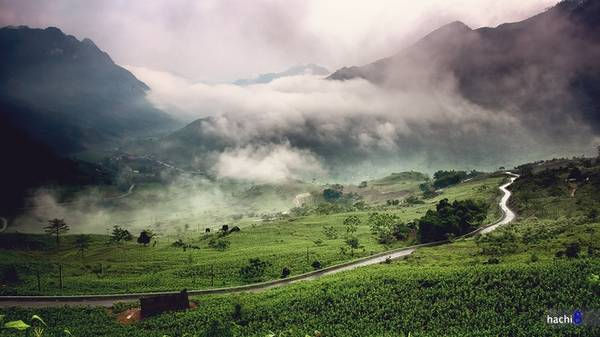
September follows the summer rainy period, so many valleys and mountain slopes remain green.
This creates a beautiful contrast between:
green mountains + golden rice terraces + cloudy skies + limestone peaks.

3. The landscape feels agricultural rather than floral
Later in autumn, many travelers come to Ha Giang specifically for buckwheat flowers.
September offers something different.
The focus is on farming, rice terraces and the relationship between local communities and the mountain landscape.
4. The weather begins to feel more autumnal
Although September can still bring rain, the intense heat of summer begins to ease.
Mountain evenings can feel noticeably cooler, particularly at higher elevations.
Ha Giang Weather in September
September is a transition period between the rainy summer and the cooler autumn months.
You should expect a mixture of:
Warm daytime temperatures
Cooler mountain evenings
Sunshine
Cloudy periods
Sudden rain
Mist in higher areas
Wet mountain roads after rainfall
The weather can vary considerably between different parts of the province.
A sunny morning does not necessarily mean that the afternoon will remain dry.
This is especially important for travelers riding motorcycles.
If you are planning a road trip, do not build your entire experience around a perfect weather forecast.
Instead, prepare for changing conditions.
The Golden Rice Terraces of Ha Giang
When people talk about Ha Giang in September, they are often talking about the rice terraces.
These terraces are not simply scenic attractions.
They are agricultural landscapes created and maintained by generations of mountain communities.
Rice is cultivated on slopes where flat agricultural land is limited.
Over time, farmers have transformed steep mountainsides into layers of fields.
During the growing season, these terraces appear green.
As harvest approaches, they gradually become yellow and golden.
The exact timing varies according to altitude, location and weather.
Therefore, you should not expect every rice terrace in Ha Giang to be golden on the same day.
This is particularly important when planning a photography trip.
Hoang Su Phi: The Main Destination for Rice Terraces
If your main reason for visiting Ha Giang in September is to see rice terraces, Hoang Su Phi should be one of the first places you research.
Hoang Su Phi is famous for its spectacular terraced fields carved into steep mountain slopes.
The landscape here is very different from the famous Dong Van–Meo Vac section of the Ha Giang Loop.
The northern Loop is famous for:
limestone mountains, deep valleys, mountain passes and the Nho Que River.
Hoang Su Phi is famous for:
rice terraces, agricultural landscapes and rural mountain communities.
Both are beautiful.
But they are different experiences.
When Is the Best Time to See the Rice in Hoang Su Phi?
There is no single date when all the rice terraces suddenly become golden.
The timing varies depending on:
Elevation
Location
Weather
Planting schedule
Local agricultural conditions
In general, September is the period when travelers can begin seeing increasingly golden rice fields.
Some areas may still be green while others are already turning yellow.
This variation is actually one of the most beautiful aspects of the season.
Instead of seeing one uniform color, you can see different stages of the agricultural cycle across the mountains.
Where to See Rice Terraces Around Hoang Su Phi
Several areas are known for their dramatic terraced landscapes.
Ban Phung
Ban Phung is famous for steep, layered rice terraces extending across mountain slopes.
The scale of the landscape becomes particularly impressive when viewed from higher ground.
Ban Luoc
Ban Luoc offers another beautiful combination of terraces, mountains and traditional villages.
It is a good destination for travelers who want to experience rural landscapes rather than simply visit a viewpoint.
Thong Nguyen
Thong Nguyen is known for mountain scenery, terraced fields and local homestay experiences.
Nam Ty
Nam Ty is another area worth exploring if you want to see rice terraces away from the busiest tourist routes.
The important point is that Hoang Su Phi is not one single viewpoint.
It is a large mountainous area.
The best experience comes from traveling through the landscape and stopping at different viewpoints, villages and terraces.
An Important Travel Tip: Don't Add Hoang Su Phi to the Classic Loop Just for the Rice
This is one of the biggest mistakes travelers can make when planning a short trip to Ha Giang.
Hoang Su Phi and the classic Ha Giang Loop are geographically and logistically different travel experiences.
If you have only a few days and try to travel:
Ha Giang City → Hoang Su Phi → Ha Giang City → Dong Van
you can spend an enormous amount of time traveling back and forth.
The mountain roads are not fast roads.
A distance that looks manageable on a map can take much longer than expected.
If your main goal is rice terraces, plan around Hoang Su Phi.
If your main goal is the Ha Giang Loop, focus on the Dong Van–Meo Vac region.
You do not need to see every famous location in one trip.
In Ha Giang, less can often mean more.
How to Reach Hoang Su Phi from Hanoi
This is another detail that many generic Ha Giang travel guides overlook.
If you are traveling from Hanoi specifically to see Hoang Su Phi, you do not necessarily need to travel all the way to Ha Giang City first.
The route from Hanoi approaches Hoang Su Phi through Tan Quang.
This makes it much more logical to turn toward Hoang Su Phi before reaching Ha Giang City.
For travelers focused on the rice harvest, this can save considerable time and avoid unnecessary backtracking.
This is one of the reasons why you should distinguish between:
Traveling to Ha Giang province
and
Traveling to Ha Giang City.
They are not always the same thing.
What About the Ha Giang Loop in September?
The Ha Giang Loop is still an excellent experience in September.
However, the attraction is different from Hoang Su Phi.
The classic Loop is about dramatic mountain scenery rather than rice terraces.
The route takes you through areas such as:
Quan Ba
Yen Minh
Dong Van
Lung Cu
Ma Pi Leng
Meo Vac
Du Gia
The landscape is dominated by limestone mountains, deep valleys and winding roads.
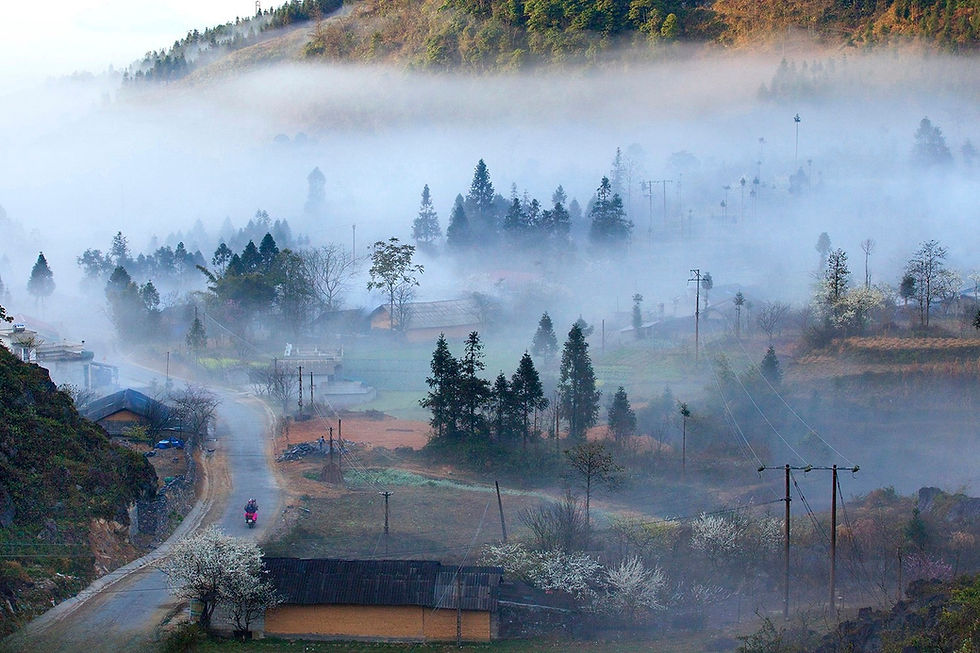
September can add atmospheric clouds and mist to the mountain scenery.
Ma Pi Leng Pass in September
Ma Pi Leng Pass is one of the most spectacular parts of the Ha Giang Loop.
The road runs between Dong Van and Meo Vac, high above the Nho Que River.
In September, you may encounter clouds or mist covering parts of the mountains.
Do not immediately assume that bad weather means a bad experience.
Mist can create an entirely different atmosphere.
The mountains may disappear for a while and then suddenly emerge as the clouds move.
However, fog and rain also mean reduced visibility.
If you are riding a motorcycle, safety should always come before photography.
Nho Que River in September
The Nho Que River is another major attraction along the Ha Giang Loop.
The river runs through the dramatic Tu San Canyon below Ma Pi Leng Pass.
The combination of turquoise-green water and towering limestone cliffs creates one of the most recognizable landscapes in northern Vietnam.
September can bring changing water and weather conditions, so travelers should follow local guidance when planning activities on or near the river.
September Is Not Buckwheat Flower Season
This is something travelers should know before booking their trip.
If you search online for photographs of Ha Giang, you will see many images of fields covered in pink, white and purple buckwheat flowers.
Those photographs are beautiful.
But September is not the main buckwheat flower season.
If you are specifically traveling to Ha Giang to see the famous buckwheat fields, you should consider traveling later in the year.
September is about something else:
rice.
The agricultural landscape is the star of the month.
This distinction is important because many generic travel articles mix together different seasons and give travelers unrealistic expectations.
What About Buckwheat Cakes in September?
You may also see buckwheat cake listed among the foods that visitors "must try" in Ha Giang.
This recommendation should be treated carefully.
Authentic buckwheat products are closely connected to the agricultural cycle of the crop.
In September, the buckwheat harvest has not yet reached the stage associated with the later flower and harvest season.
For that reason, buckwheat cake should not be presented as a signature September food experience.
If you visit Ha Giang in September, focus instead on the foods that are genuinely available at local markets and restaurants throughout the year.
What to Eat in Ha Giang in September
September is a good time to explore local mountain cuisine.
Instead of searching for seasonal buckwheat products that may not yet be available, try dishes that are genuinely part of everyday local food culture.
Thang Co
A traditional dish strongly associated with H'Mong culture.
You are most likely to encounter it at local markets and traditional eateries.
Au Tau Porridge
A distinctive Ha Giang specialty made with rice and au tau.
It is particularly enjoyable on cool mountain evenings.
Ha Giang Sour Pho
A local style of pho with a distinctive sweet-and-sour flavor.
It is very different from the classic Hanoi-style pho.
Smoked Buffalo Meat
A traditional preserved meat found in northern mountain communities.
Local Market Food
One of the best ways to discover Ha Giang's food culture is simply to visit a local market.
Instead of looking for a restaurant designed specifically for tourists, observe what local people are eating.
That will usually tell you more about the region's food culture.
What Should You Wear in Ha Giang in September?
You do not need heavy winter clothing.
But you should prepare for changing mountain weather.
Pack:
Lightweight trousers
T-shirts
Long-sleeved shirts
Light jacket
Waterproof rain jacket
Comfortable walking shoes
Extra socks
Sun protection
If you ride a motorcycle, rain protection becomes even more important.
A waterproof jacket and waterproof protection for your phone and camera can make a huge difference.
Is September a Good Month for Motorcycling?
Yes, but riders need to understand the conditions.
The roads of Ha Giang are mountainous and include:
Steep climbs
Sharp bends
Narrow sections
High passes
Changing visibility
Wet surfaces after rain
Rain can make the roads considerably more difficult.
If you are an experienced motorcycle rider, September can still be an excellent time to ride.
If you are not confident on a motorcycle, consider using an Easy Rider.
This allows you to enjoy the landscape without having to manage difficult mountain roads yourself.
Traveling to Ha Giang by Sleeper Bus
For travelers coming from Hanoi, the easiest way to reach Ha Giang City is often a sleeper bus.
This is particularly convenient if your main trip is the classic Ha Giang Loop.
An overnight journey means you can leave Hanoi in the evening, sleep during the trip and arrive in Ha Giang ready to begin your mountain adventure.
Ha Giang Buslines
Ha Giang Buslines provides sleeper and cabin bus services connecting Hanoi and Ha Giang.
For international travelers, a cabin-style sleeper can be a comfortable option for the long journey.
Before booking, check:
Departure time
Pickup point
Arrival time
Cabin type
Luggage allowance
Drop-off point
Cancellation conditions
If you are traveling specifically to Hoang Su Phi, however, your transportation strategy should be considered separately because going into Ha Giang City first can create unnecessary backtracking.
This is an important distinction between traveling to Ha Giang Province and traveling to Ha Giang City.
What Should You Pack for a September Trip?
Travel light.
If you are traveling by motorcycle, a large suitcase can quickly become inconvenient.
A small backpack is much easier.
Essential items
Light clothing
Light jacket
Rain jacket
Comfortable shoes
Waterproof bag
Power bank
Sunscreen
Sunglasses
Personal medication
Cash
Offline maps
If photography is important to you, bring protection for your camera equipment.
A sudden mountain shower can happen even when the morning begins with clear skies.
Photography Tips for Ha Giang in September
September is an excellent month for landscape photography.
The most interesting photographs often combine several layers:
foreground: rice terraces or local people
middle ground: villages and mountains
background: mist-covered peaks
Early morning and late afternoon generally offer the most atmospheric light.
But don't spend the entire day searching for the perfect viewpoint.
Some of the best photographs may come from simply stopping along the road when you see an interesting valley or farming scene.
Always stop in a safe location, especially if you are traveling by motorcycle.
Respect the People Behind the Landscape
It is easy to look at a golden rice terrace and see only a beautiful photograph.
But remember that the rice field is someone's livelihood.
The farmers who created these terraces are not part of a tourist attraction.
They are working.
When visiting villages and agricultural areas:
Ask before photographing people.
Do not walk through fields without permission.
Do not disturb farmers while they are working.
Do not enter private homes without permission.
Keep noise levels low.
Take your rubbish with you.
A beautiful photograph is never more important than someone's privacy or livelihood.
What to avoid when visiting Ha Giang in September?
If you are planning to visit Ha Giang in early September 2026, there is one important factor you should consider: Vietnam's National Day holiday.
In 2026, Vietnam will have an extended public holiday from August 28 to September 2, creating a six-day holiday period for many Vietnamese people.
During this period, many local residents take the opportunity to travel, and popular destinations across northern Vietnam can become significantly busier than usual.
Ha Giang may also experience higher demand for:
Hotels and homestays
Sleeper buses from Hanoi
Motorbike rentals
Easy Rider services
Restaurants
Popular viewpoints and attractions
Roads can also become busier, particularly on the main routes connecting Hanoi with Ha Giang and around popular destinations on the Ha Giang Loop.
Should You Visit Ha Giang in September?
If your priority is rice terraces, mountain landscapes and authentic rural experiences, September is an excellent month to consider.
But you need to choose the right part of Ha Giang.
For golden rice terraces:
Think Hoang Su Phi.
For the classic mountain adventure:
Think Dong Van – Ma Pi Leng – Meo Vac – Du Gia.
For buckwheat flowers:
Wait until later in the year.
And if you only have a few days, don't try to cover everything.
Ha Giang is a mountainous province where distances on a map do not tell the whole story.
The roads are slow.
The scenery deserves time.
And the best experiences often happen when you stop moving.
The Real Beauty of Ha Giang in September
Ha Giang in September is not about one flower, one viewpoint or one famous road.
It is about a landscape changing before your eyes.
The rice that has been growing throughout the summer begins to turn golden.
Farmers prepare for harvest.
Clouds move across the mountain peaks.
The valleys remain green.
The roads wind through the highlands.
And villages continue their daily lives among some of the most spectacular scenery in Vietnam.
That is what makes September special.
You are not simply visiting Ha Giang during a beautiful season.
You are arriving at a moment when the mountains are preparing for harvest.


Comments